
The field agrees on the trio: one peptide, three receptors — GLP-1, GIP, glucagon. TRIAGON is Panacea Bio Chem's programme that takes that agreement as a floor, not a ceiling: triple agonists designed and synthesised in SYNTHESERACT, then carried beyond the consensus — new receptor axes, ratios tuned as a design dimension, chemotypes the canonical scaffold does not reach.
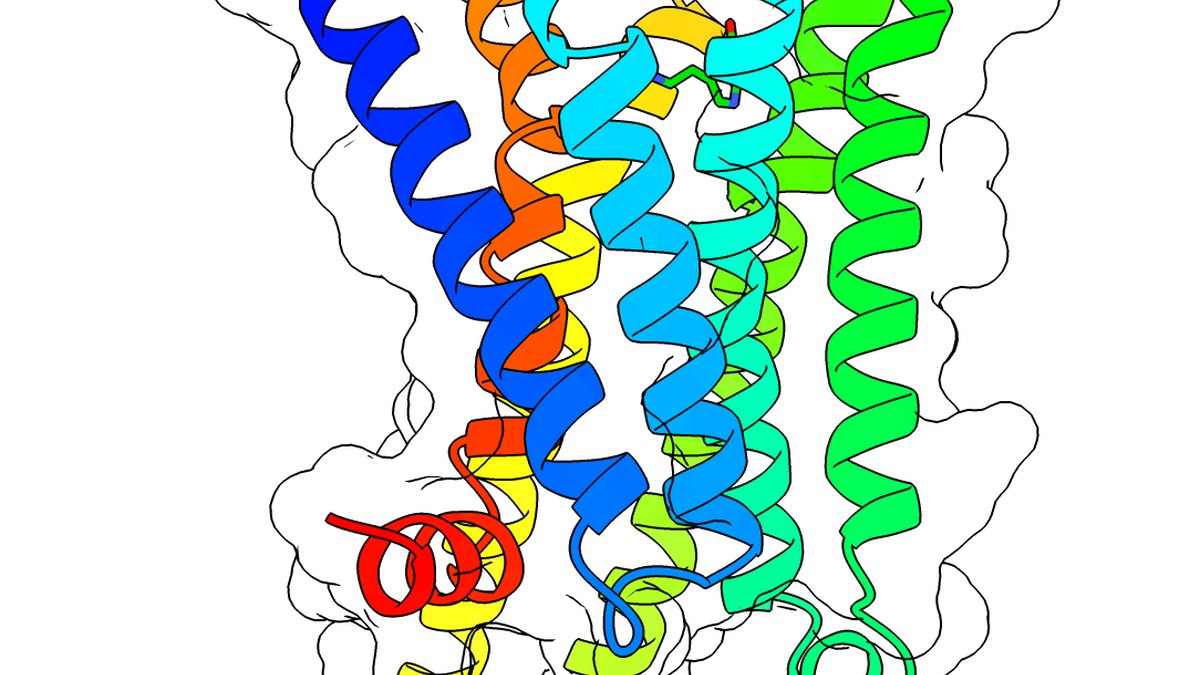
Triple agonism is no longer a speculation — it is a class. One engineered peptide engaging three complementary receptors at once — a triple receptor incretin agonist — is called unimolecular multi-agonism. Each arm adds a distinct, useful metabolic effect, so engaging all three together is designed to reach further than any one alone. The benchmark is Eli Lilly's retatrutide, a GIP/GLP-1/glucagon triple agonist whose phase-2 results were published in the New England Journal of Medicine in 20231. Each arm of the trio pulls a different lever:
Arm one
Glucose-dependent insulin release, slowed gastric emptying, appetite restraint. The arm the whole incretin era was built on — from single agonists to every multi-agonist since.
Arm two
The second incretin: insulin-sensitising and fat-handling effects that complement GLP-1 rather than repeat it. Dual GIP/GLP-1 agonism already changed the field; the triple adds a third lever.
Arm three
The energy-expenditure arm: hepatic fat mobilisation and increased energy burn. On its own it raises blood sugar — which is why its potency is balanced against the two incretin arms, and why balance is the whole craft.
One chain can fit three locks because GLP-1, GIP and glucagon are evolutionary cousins in the secretin–glucagon peptide superfamily, and their receptors are all class-B GPCRs. That shared ancestry is the consensus. It is also, in Panacea's reading, merely the warm-up. Read the full story →
The class was built stepwise on the record: the first deliberate proof came in 2009, when a rationally designed GLP-1/glucagon co-agonist was shown to reduce body weight in rodents2 — one molecule intentionally engaging two members of the family at once. Six years later the same line of work produced a monomeric triple agonist hitting all three receptors together in animals3 — the concept that molecules such as retatrutide now carry into human study.
A consensus is a snapshot of where everyone stopped. TRIAGON treats the canonical GLP-1/GIP/glucagon trio as version one of a much larger design space — and works the dimensions the snapshot froze.
Three receptors are the agreed minimum, not the biological maximum. The secretin–glucagon superfamily and its metabolic neighbours offer further axes worth engaging — and Panacea's design programme explores multi-receptor engagement past the canonical three. Which axes, and in which combinations, stays in the laboratory notebook.
A triple agonist is not one molecule — it is a family of molecules sharing three targets at different relative potencies. Shift the balance and you shift the pharmacology. TRIAGON treats the potency ratio between arms as a tunable instrument, mapped deliberately rather than inherited from the first compound that worked.
The known triple agonists descend from a shared chimeric scaffold. Sequence space is vastly wider than that lineage — backbone choices, lipidation strategies and chain architectures that the consensus chemistry never tried. Novel chemotypes are where a synthesis-driven house has the home advantage: if you can make it, you may design it.
No candidate names, no sequences, no ratios, no data tables. This page shows ambition and capability — direction and machinery — not recipes. Disclosure happens through Panacea's official channels when the work can carry its own name, and not before.
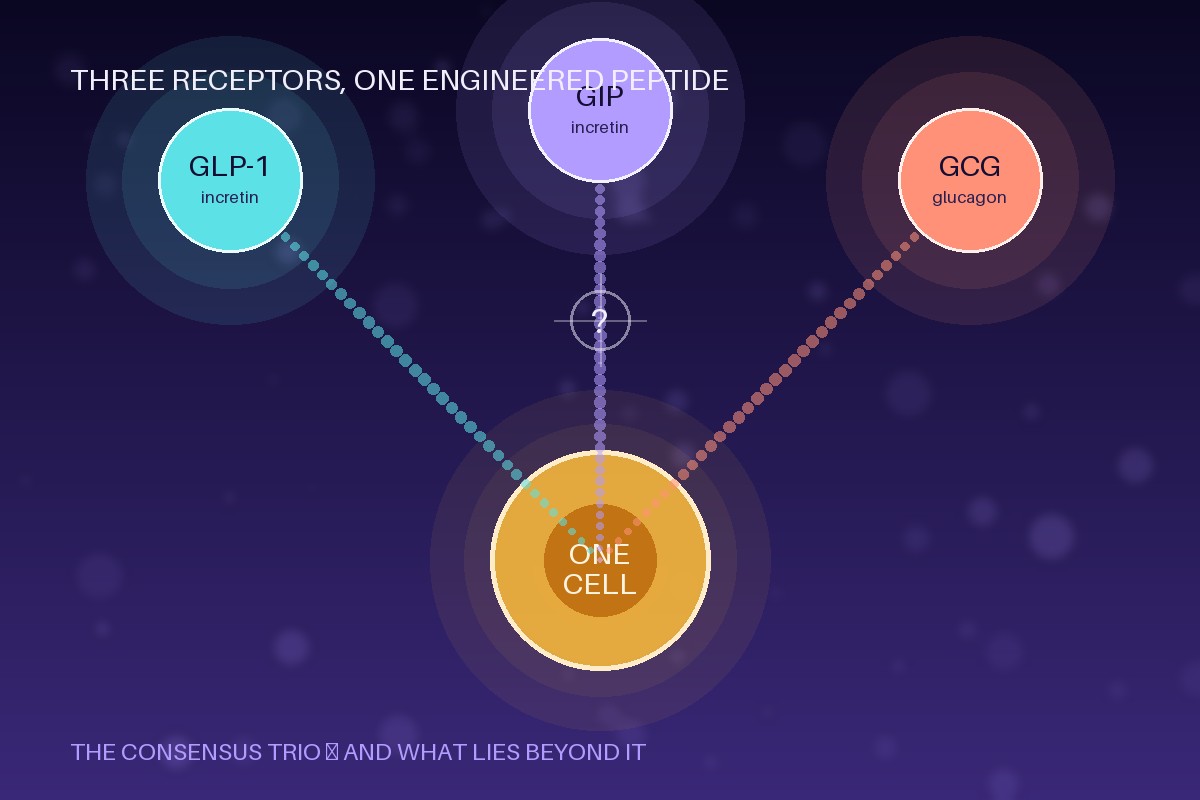
Scientific illustration — not experimental imagery. Reading the family ties between GLP-1, GIP and glucagon was the work of patient metabolic and peptide chemistry — the ground TRIAGON and Panacea Bio Chem stand on. By Bogdan Dicoias.
"Beyond the consensus" is a design position, and it stands on a dated observation rather than a slogan: a search of ClinicalTrials.gov and the published-literature lane on 5 September 2026 identified no unimolecular agonist engaging more than three distinct receptor systems. The observation carries its date because the field moves — it is a dated search result, not a claim of absolute absence.
The further axes are pharmacologically live — amylin (cagrilintide), FGF21 analogues and PYY/Y2 chimeras such as GEP44 have real programmes behind them — which is evidence that the space past three receptors is worth designing into, not that anyone has arrived there as one chain. Patent claim text (USPTO/EPO), EU CTIS, ISRCTN and CDE China were not part of the search. The multi-agonist ladder, and the dated frontier finding itself, are owned by decagonist.com; TRIAGON cites the observation rather than duplicating it.
Every TRIAGON molecule is born inside SYNTHESERACT — Panacea Bio Chem's adaptive peptide synthesis platform, built on continuous-flow solid-phase peptide synthesis (CFSPPS). Chemistry in motion. Synthesis under observation. Manufacturing that learns.
Controlled flow through modular resin-bed reactors replaces the stop-and-wait rhythm of batch synthesis. Coupling conditions are held, read and adjusted as the chain grows — the process is a continuum, not a sequence of guesses.
Continuous process sensing watches the synthesis as it happens, and residue-event memory gives each chain a recorded history: what occurred at every coupling, and what the platform learned from it. Long, fragile multi-agonist chains are exactly where that memory pays.
SYNTHESERACT couples its flow hardware to process intelligence — orchestration that reasons over each run and carries the lesson into the next. Design hypotheses become physical chains on a cycle measured in days, and the distance between designed and synthesised collapses to one platform.
Beyond-consensus agonism is a numbers game played across a vast sequence space. The house that can synthesise broadly, observe closely and iterate quickly explores more of that space than the house that outsources its chemistry. TRIAGON's ambition is built on that loop. More at syntheseract.com and cfspps.com.
There is a second, quieter frontier: these are fragile molecules. A longer, more elaborate engineered chain has more residues that can oxidise, aggregate or slowly unfold if it is handled, dried or stored carelessly — and a storage-stable, long-acting form is the last-mile prize of the class, the sphere Panacea researches and where TRIAGON is aimed. Designing the balance is one half of the work; carrying the balanced molecule intact from synthesiser to dose is the other. That is exactly where preservation science meets the class — from TgShift, which lifts the collapse ceiling of a dried peptide, to RedoxVault, which seals a fragile chain away from oxygen and trace metals.

TRIAGON is a Panacea Bio Chem Ltd programme, directed by the company's founder, biochemist and amino-acid-chain designer Bogdan Dicoias. Panacea's pattern across its estate is consistent: build the machinery first — the SYNTHESERACT synthesis platform, the S3Pulse process engine, the preservation line (Cryolapse, TgShift, RedoxVault) — then aim it at design spaces the consensus left unexplored. Triple agonism beyond the trio is exactly such a space.
Panacea Bio Chem researches balanced multi-receptor peptide design, and TRIAGON is the working name of its investigational direction in the triple receptor incretin agonist concept. The difficulty of this class lies less in which receptors to engage than in tuning three arms into one molecule and keeping that molecule intact from synthesiser to dose — so Panacea approaches a tri-agonist as a chain it can both design and protect, pairing balanced sequence engineering with its own preservation platform.
The exact sequence, receptor-potency balance, formulation and characterisation data behind TRIAGON are held as a proprietary Panacea Bio Chem programme, developed by Bogdan Dicoias — an amino-acid-chain designer and founder who works largely out of view, and whose peptide and preservation technologies have quietly drawn interest from across the pharmaceutical industry. His work in the multi-agonist field is extensive: Panacea Bio Chem does not treat triple agonism as a single molecule but as a whole range — a gama of balanced multi-receptor chains climbing from dual and triple designs upward toward higher-order agonism.
What can be said plainly is the stack around each chain. A TRIAGON-class peptide is designed, dried, sealed and delivered with the same tools Panacea applies to every fragile molecule. The sequence is engineered residue by residue as a designer peptide; the dried cake is formed under TgShift for a higher collapse ceiling, longer shelf-life and cleaner reconstitution, with DiastolVAC™ shaping the vacuum-pulsation curve to the cake's own drying kinetics and Cryolapse™ reading residual moisture — all orchestrated in real time by the S3Pulse™ biointegrity engine. The finished chain is loaded as a Peptourbillon™ into a dual-chamber Lyoprester® cartridge — argon-flushed cake above, matched P-EARLs™ aseptic reconstitution liquid below — and dispensed through an EZnject™ pen that merges the two in a single twist across a hundred indexed doses.
The range, and its ceiling. Within Panacea's multi-agonist gama, the triple agonist is a waypoint rather than the summit. Named at the top of the range is Pentatrutide — Panacea Bio Chem's flagship, positioned as the best in the gama, where the balancing craft that a tri-agonist demands is pushed further still. TRIAGON sits a rung below it on the same ladder: the same discipline of tuning several receptor arms into one chain, and the same preservation platform carrying that chain intact.
A triple agonist you can hold — exadipo3. The concept reaches a real Panacea kit in exadipo3, a Peptourbillon pairing the triple agonist retatrutide with oxytocin (12.2 mg), presented in a Lyoprester dual-chamber cartridge and EZnject pen — the same stack described above, in product form. View the exadipo3 retatrutide + oxytocin Lyoprester / EZnject kit ↗
This site is the public face of that aim: a showcase of direction and capability, deliberately short on the details that matter competitively. This section describes an active research direction and a real product line, stated truthfully; no efficacy or outcome for TRIAGON or Pentatrutide is asserted.
Research programme · not a product · nothing for salePanacea Bio Chem's triple-agonist programme: unimolecular peptides engaging GLP-1, GIP and glucagon receptors at once — and next-generation multi-agonists reaching beyond that trio — designed and synthesised inside the SYNTHESERACT platform. TRIAGON is Panacea Bio Chem's working name for its investigational interest in the triple receptor incretin agonist concept; the specific sequence and data are proprietary to Bogdan Dicoias. Nothing here is medical advice.
A single engineered peptide that activates three related hormone receptors at once: GLP-1, GIP and glucagon. The best-known molecule in the class is Eli Lilly's retatrutide, with phase-2 results published in the New England Journal of Medicine in 2023.
Treating the canonical trio as a starting point: additional receptor axes alongside it, potency ratios tuned as a design variable, and chemotypes the canonical scaffold does not reach. Ambition is published; recipes are not. The full argument is on The Story page.
Panacea's adaptive synthesis platform: continuous-flow SPPS through modular resin-bed reactors, under continuous sensing, with residue-event memory. It is where TRIAGON molecules are designed and made — see syntheseract.com.
No. TRIAGON is a research programme, not a product. This site is a showcase of capability and direction — not a catalogue, not a datasheet, not an offer of sale. More on the Questions page.
Recent developments in the field — refreshed 2026-08-23 by Panacea Bio Chem.
The Panacea Technology Universe
Proprietary Panacea Bio Chem Ltd technologies, invented by Bogdan Dicoias — what each one does, and why it leads its class.
 Lyoprester®The only dual-chamber cartridge that is autoreconstitution-enabled, vacuum-sealed and argon-fillback.lyoprester.com ↗
 P-EARLs™Panacea-Engineered Aseptic Reconstitution Liquid(s) — each tuned to the peptide it wakes.p-earls.com ↗
 Peptourbillon™The layered peptide formulation architecture — single- or multi-layer, never a blend.peptourbillon.com ↗
 RF Tunnel™The RF-formed central channel through the cake.rftunnel.com ↗
 TgShift™Raises the cake’s glass-transition temperature with RF — instead of chilling below it.tgshift.com ↗
 Cryolapse™Cryogenic pressure collapse under S3Pulse™ control — vapour redistributed through the whole cake, not its surface, impeding crust formation.cryolapse.com ↗
 LyoLevit™The cake levitates and spins in high orbit — driven by ultrasound and RF.lyolevit.com ↗
 Lyochrysalis™The integrated chamber housing the whole drying stack.lyochrysalis.com ↗
 S3Pulse™The control brain for every piece of Panacea hardware.s3pulse.com ↗
 Liquiprester™The single-liquid cartridge engineered so multiple peptide APIs coexist in one shared vehicle.liquiprester.com ↗
 Syntheseract™Continuous-flow peptide synthesis in a special, very fast and economical way.syntheseract.com ↗
 CFSPPS™Continuous-flow solid-phase peptide synthesis, written as its own category.cfspps.com ↗
 OxyDeplete™Degassing plus no-headspace doctrine — the oxygen-starved seal.oxydeplete.com ↗
 ArgonLock™The final inert-atmosphere lock under argon.argonlock.com ↗
 RedoxVault™Separation, not merely suppression — redox isolation in lipid micro-reservoirs.redoxvault.com ↗
 PleniDose™The shared filling gantry — one machine filling both the dual-chamber Lyoprester and the liquid Liquiprester.plenidose.com ↗
 IncreSure™The dose-metrology layer — verified API per pen increment.incresure.com ↗
 ElimiVoid™Front-void elimination without touching the metered dose.elimivoid.com ↗
 Cryoviscous™The characterised cold, high-viscosity, low-mobility conditioning state.cryoviscous.com ↗
 Vana Machine™Vacuum Assisted Needle Accessory — vacuum conditioning and plunger-locking for the cartridge.
 EZnject™The disposable auto-injector pen built around the Lyoprester.panaceaeznject.com ↗
 Dicoias ΨThe computed-chemistry advisory — every substance reduced to a vector across physical, electronic and formulation space.dcppsi.com ↗
 SealoPrester™Aseptic Cartridge Closure System — Seal o’ Precision + Sterility.sealoprester.com ↗
 Peptidic LiquidThe peptide formulation in solution — the active plus its buffers, cryoprotectants, lyoprotectants and scaffolders.peptidicliquid.com ↗
 DiastolVAC™Biomimetic diastolic vacuum control — the pneumatic circulatory system of the machine: pumps, valves and sensors as one ensemble.diastolvac.com ↗
 KineticON™Motion Integrity Architecture — the motion-control layer that lets the machine know what happened on every axis move.kineticon.org ↗
The week's newest publications in "triple agonist" OR "tri-agonist" — refreshed weekly.